Sunbeamer
Frolicking In a Euro-spec 323i Cabriolet
by Kevin
Smith
PHOTOGRAPHY BY JIM BROWN
Already you're sighing, "Here they go
again, teasing me with another tantalizing
European car that we can't get over here." 0h ye of little
faith.
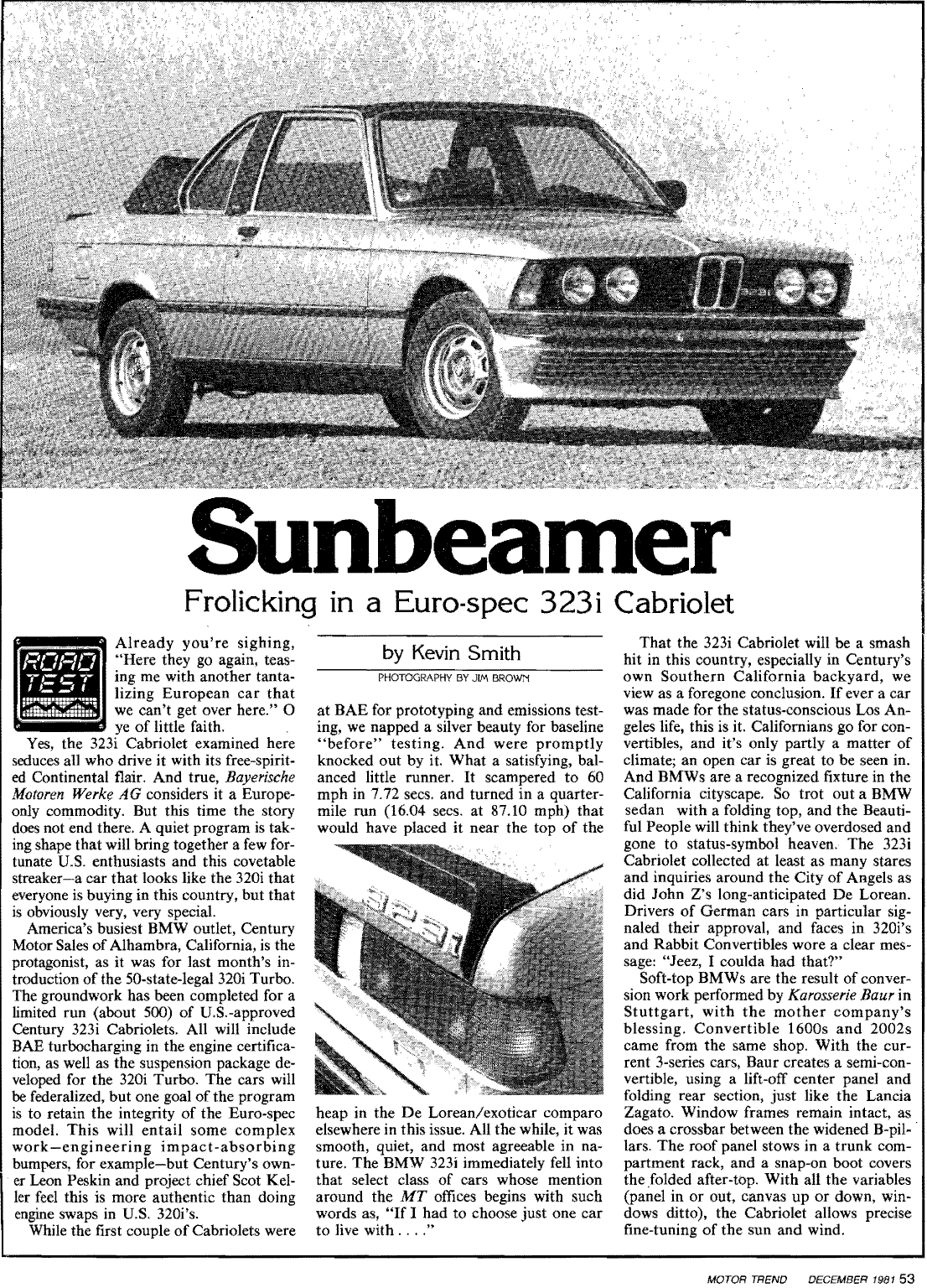
Yes, the 323i Cabriolet examined here seduces all who drive it
with its free-spirited Continental flair. And true, Bayerische Motoren Werke AG
considers it a Europe-only commodity. But this time the story does not end
there. A quiet program is taking shape that will bring together a few fortunate
U.S. enthusiasts and this covetable streaker - a car that looks like the 320i
that everyone is buying in this country, but that is obviously very, very
special.
America's busiest BMW outlet, Century Motor Sales of Alhambra,
California, is the protagonist, as it was for last month's introduction of the
50-state-IegaI 320i Turbo. The groundwork has been completed for a limited run
(about 500) of U.S. - approved Century 323i Cabriolets. All will include BAB
turbocharging in the engine certification, as well as the suspension package
developed for the 320i Turbo. The cars will be federalized, but one goal of the
program is to retain the integrity of the Euro-spec model. This will entail some
complex work-engineering impact-absorbing bumpers, for example-but Century's
owner Leon Peskin and project chief Scot Keller feel this is more authentic than
doing engine swaps in U.S. 320i's.
While the first couple of Cabriolets
were at BAE for prototyping and emissions testing, we napped a silver beauty for
baseline "before" testing. And were promptly knocked out by it. What a
satisfying, balanced little runner. It scampered to 60 mph in 7.72 sees and
turned in a quarter mile run (16.04 secs. at 87.10 mph) that would have placed
it near the top of the heap in the De Lorean/exoticar comparo elsewhere in this
issue. All the while, it was smooth, quiet, and most agreeable in nature. The
BMW 323i immediately fell into that select class of cars whose mention around
the MT offices begins with such words as, "If I had to choose just one car to
live with ....”
That the 323i Cabriolet will be a smash hit in this
country, especially in Century's own Southern California backyard, we view as a
foregone conclusion. If ever a car was made for the status-conscious Los Angeles
life, this is it. Californians go for
convertibles, and it's only partly a matter of
climate; an open car is great to be seen in. And BMWs are a recognized fixture
in the California cityscape. So trot out a BMW sedan with a folding top, and the
Beautiful People will think they've overdosed and gone to status-symbol heaven.
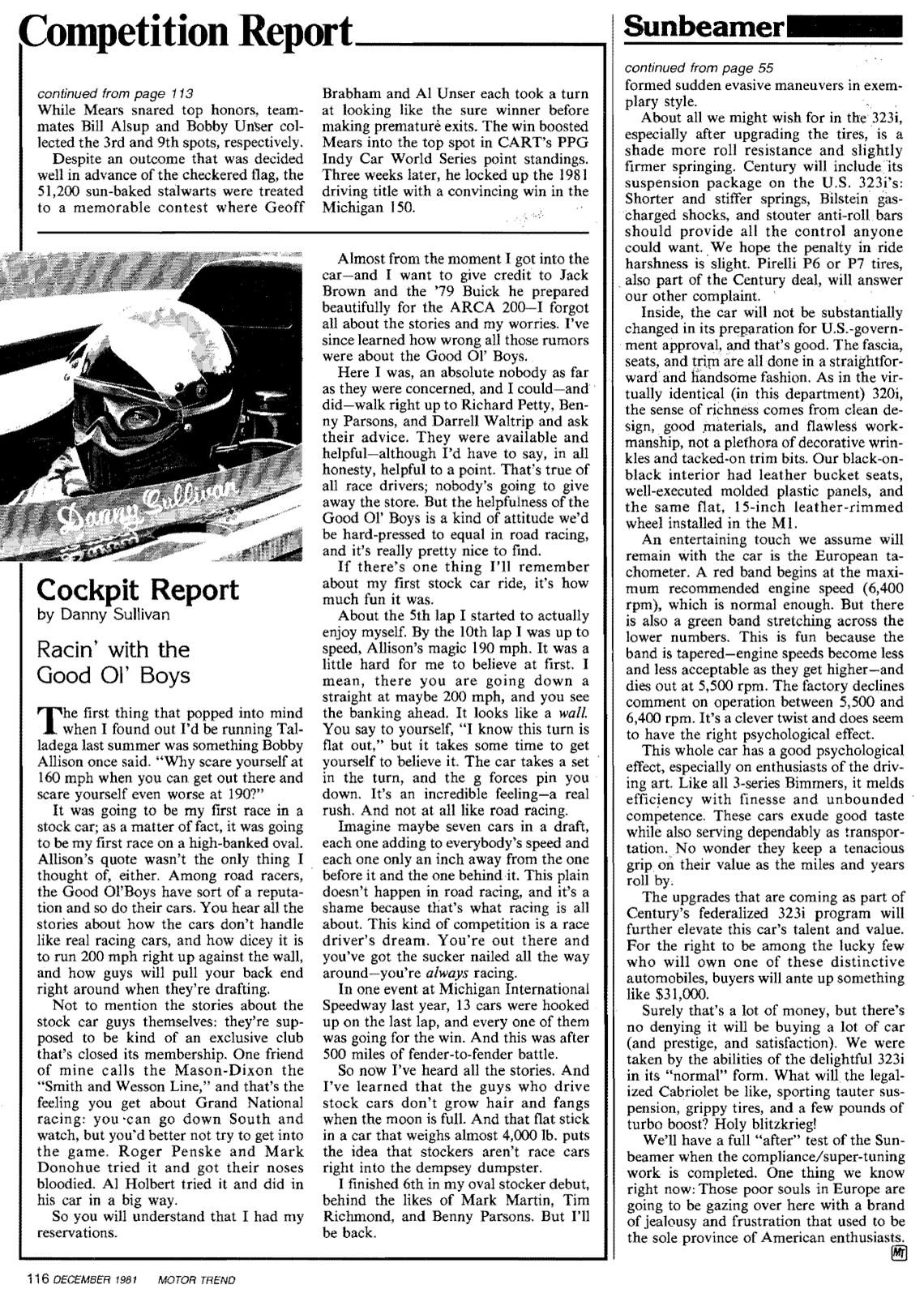
The 323i Cabriolet collected at least as many stares and inquiries around the
City of Angels as did John Z's long-anticipated De Lorean. Drivers of
German cars in particular signaled their approval, and
faces in 320i's and Rabbit Convertibles wore a clear message: "Jeez, I coulda
had that?"
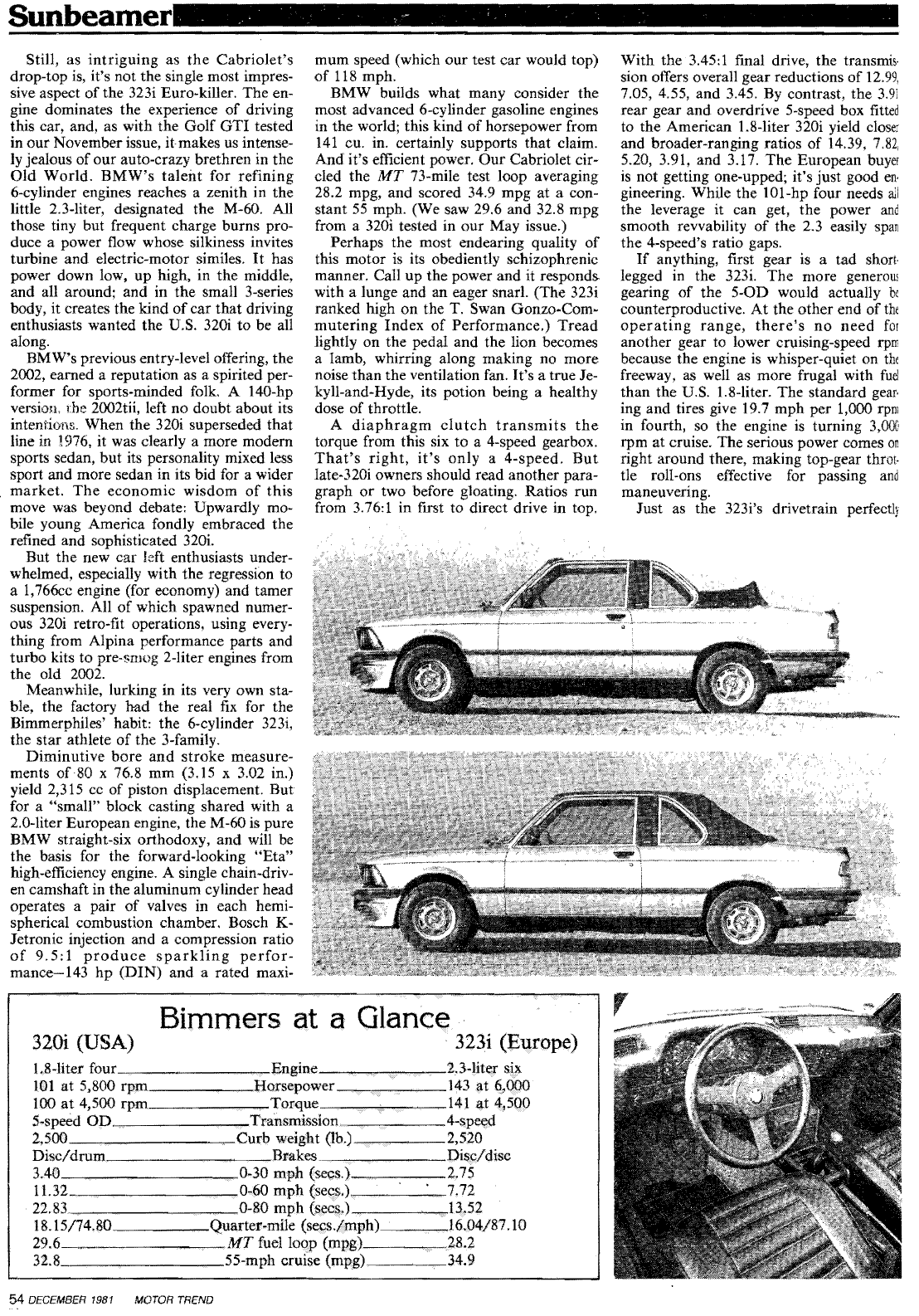
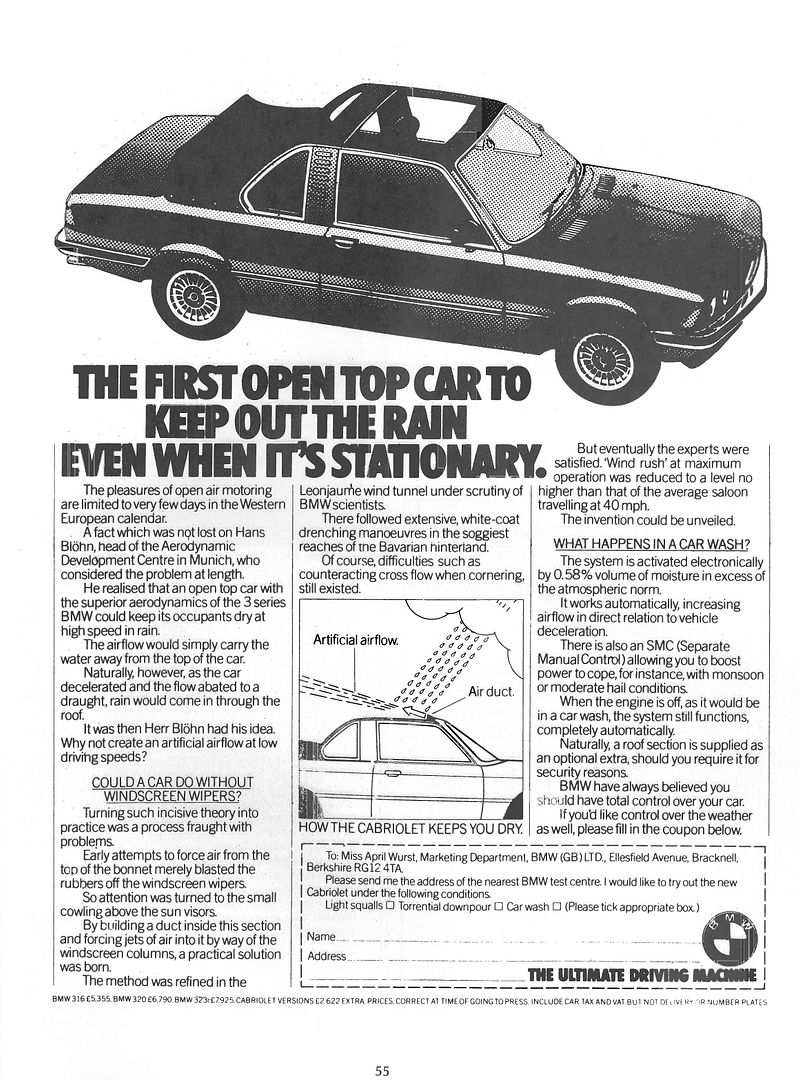
Soft-top BMWs are the result of conversion work performed by
Karosserie Baur in Stuttgart, with the mother company's blessing. Convertible
1600s and 2002s came from the same shop. With the current 3-Series cars, Baur
creates a semi-convertible, using a lift-off center panel and folding rear
section, just like the Lancia Zagato. Window frames remain intact, as does a
crossbar between the widened B-pillars. The roof panel stows in a trunk
compartment rack, and a snap-on boot covers the folded after-top. With all the
variables (panel in or out, canvas up or down, windows ditto), the Cabriolet
allows precise fine-tuning of the sun and wind.
Still, as intriguing as
the Cabriolet's drop-top is, it's not the single most impressive aspect of the
323i Euro-killer. The engine dominates the experience of driving this car, and,
as with the Golf GTI tested in our November issue, it-makes us intensely jealous
of our auto-crazy brethren in the Old World.
BMW's talent for refining 6-
cylinder engines reaches a zenith in the little 2.3-liter,
designated the M-60. All those tiny but frequent charge burns produce a power
flow whose silkiness invites turbine and electric-motor similes. It has power
down low, up high, in the middle, and all around; and in the small 3-series
body, it creates the kind of car that driving enthusiasts wanted the U.S. 320i
to be all along.
BMW's previous entry-level offering, the 2002, earned a
reputation as a spirited performer for sports-minded folk. A 140-hp version, the
2002tii, left no doubt about its intentions. When the 320i superseded that line
in 1976, it was clearly a more modern sports sedan, but its personality mixed
less sport and more sedan in its bid for a wider market. The economic wisdom of
this move was beyond debate: Upwardly mobile young America fondly embraced the
refined and sophisticated 320i.
But the new car left enthusiasts
underwhelmed, especially with the regression to a 1,766cc engine (for economy)
and tamer suspension. All of which spawned numerous 320i retro-fit operations,
using everything from Alpina performance parts and turbo kits to pre-smog
2-liter engines from the old 2002.
Meanwhile, lurking in its very own
stable, the factory had the real fix for the Bimmerphiles' habit: the 6-cylinder
323i, the star athlete of the 3-family.
Diminutive bore and stroke
measurements of 80 x 76.8 mm (3.15 x 3.02 in.) yield 2,315 cc of piston
displacement. But for a "small" block casting shared with a 2.0-liter European
engine, the M-60 is pure BMW straight-six orthodoxy, and will be the basis for
the forward-looking "Eta" high-efficiency engine. A single chain-driven camshaft
in the aluminum cylinder head operates a pair of valves in each hemispherical
combustion chamber. Bosch KJetronic injection and a compression ratio of 9.5:1
produce sparkling performance-143 hp (DIN) and a rated maximum speed (which our
test car would top) of 118 mph.
BMW builds what many consider the most
advanced 6-cylinder gasoline engines in the world; this kind of horsepower from
141 cu. in. certainly supports that claim. And it's efficient power. Our
Cabriolet circled the MT 73-mile test loop averaging 2S.2 mpg, and scored 34.9
mpg at a constant 55 mph. (We saw 29.6 and 32.8 mpg from a 320i tested in our
May issue.)
Perhaps the most endearing quality of this motor is its
obediently schizophrenic manner. Call up the power and it responds with a lunge
and an eager snarl. (The 323i ranked high on the T. Swan Gonzo-Commutering Index
of Performance.) Tread lightly on the pedal and the lion becomes a lamb,
whirring along making no more noise than the ventilation fan. It's a true
Jekyll-and-Hyde, its potion being a healthy dose of throttle.
A diaphragm
clutch transmits the torque from this six to a 4-speed gearbox. That's right,
it's only a 4-speed. But late-32Oi owners should read another paragraph or two
before gloating. Ratios run from 3.76:1 in first to direct drive in
top.
With the 3.45:1 final drive, the transmission offers overall gear
reductions of 12.99, 7.05, 4.55, and 3.45. By contrast, the 3.91 rear gear and
overdrive 5-speed box fitted to the American 1.8-liter 320i yield close and
broader-ranging ratios of 14.39, 7.82, 5.20, 3.91, and 3.17. The European buyer
is not getting one-upped; it’s just good engineering. While the 101-hp four
needs ail the leverage it can get, the power and smooth revvability of the 2.3
easily span the 4-speed's ratio gaps.
If anything, first gear is a tad
short legged in the 323i. The more generous gearing of the 5-OD would actually
be counterproductive. At the other end of the operating range, there's no need
for another gear to lower cruising-speed rpm' because the engine is
whisper-quiet on the freeway, as well as more frugal with fuel than the U.S.
1.8-liter. The standard gearing and tires give 19.7 mph per 1,000 rpm in fourth,
so the engine is turning 3,000 rpm at cruise. The serious power comes on right
around there, making top-gear throttle roll-ons effective for passing and
maneuvering.
Bimmers at a Glance
320i (USA) 323i
(Europe)
L.8-liter four ____________ Engine ____________ 2.3-liter six
101
at 5,5OO rpm ______ Horsepower _________ 143 at 6,000
100 at 4,500
rpm_________ Torque____________ 141 at 4,500
5-speed ___________ OD
Transmission ________ 4-speed
2,500 _____________ Curb weight (lb.) ________
2,520
Disc/drum _____________ Brakes ____________
Disc/disc
3.40______________ 0-30 mph (secs.) _________ 2.75
1l.32
_____________ 0-60 mph (secs.) _________ 7.72
22.83 _____________ 0-80 mph
(secs.) _________ 13.52
18.15/74.80 ____ Quarter-mile (secs./mph) ______
16.04/87.10
29.6 _________ MT fuel loop (mpg) _________ 28.2
32.8 55
__________ mph cruise (mpg) __________ 34.9
Just as the 323i's drivetrain
perfectly matches power characteristics and mechanical advantage, so its chassis
happily reconciles bump absorption and accurate response. The layout is now-
traditional BMW - coil springs at each comer with MacPherson struts in front and
semi-trailing arms in back. The American 320i lost its rear anti-roll bar as
part of the effort to soften the car and reduce the famous trailing-throttle
over steer, at the expense of roll resistance and peak cornering power. The
hotter-blooded 323i, however, comes through with anti-roll bars at each
end.
Brakes also receive an upgrade to handle the potency of the
small-six engine. Our Cabriolet boasted discs fore and aft, vented in front.
Solid discs up front and drums in back stop the 3-series cars equipped with
1.6-, 1.8-, and 2.0-liter engines.
Steel wheels 5.5 in. wide mount
185/70HR13 radials, which do a good job of protecting the wheel rims, but that's
about all. The car felt undertired from the start. Michelin XVS tires are a few
generations behind the best performance rubber available today, and in spite of
their 70-series designation, the tires on this BMW appeared rather antediluvian:
tall at the shoulders and narrow across the tread face.
More modern
(shorter and livelier) tire sidewalls would quicken the already good steering
response, while stickier footprints would make better use of the engine's
prodigious power. More traction would also reduce the tendency for the tail to
come about when the throttle is abruptly closed in a hard turn, or at least
raise the speed at which it happens. This familiar BMW trait allows control of
the cornering arc with throttle, though the driver had best be mindful of the
limit. In an over-one's-head encounter with a surprise decreasing-radius turn,
it can give the panic-prone a fast, tail-first trip into the
tules.
MPG
Car: BMW 323i Cabriolet
EPA City
.............................................. N.A.
EPA Highway
..................................... N.A.
MT Test Loop
.................................... 28.2
Steady-state 55 mph
................................................. 34.9
Driving range
(steady-state 55 mph x fuel capacity) ................................... 534
miles
Overall, the 323i chassis carries on the theme of silkiness
established by that jewel of a motor. The suspension .smothers bumps in a
fashion rivaling the heavier ultra-tech 928. Road noise reaching the cockpit is
also minimal. Yet there is no vague, rubbery feel-often the price for isolation
from road surface nasties. The car is taut and thoroughly predictable. Steering
is on the heavy side, the ZF rack-and-pinion gear justifying its required effort
with positive, direct response. Our test car formed sudden evasive maneuvers in
exemplary style.
About all we might wish for in the 323i, especially
after upgrading the tires, is a shade more roll resistance and slightly firmer
springing. Century will include its suspension package on the U.S. 323i's:
Shorter and stiffer springs, Bilstein gas charged shocks, and stouter anti-roll
bars should provide all the control anyone could want. We hope the penalty in
ride harshness is slight. Pirelli P6 or P7 tires, also part of the Century deal,
will answer our other complaint.
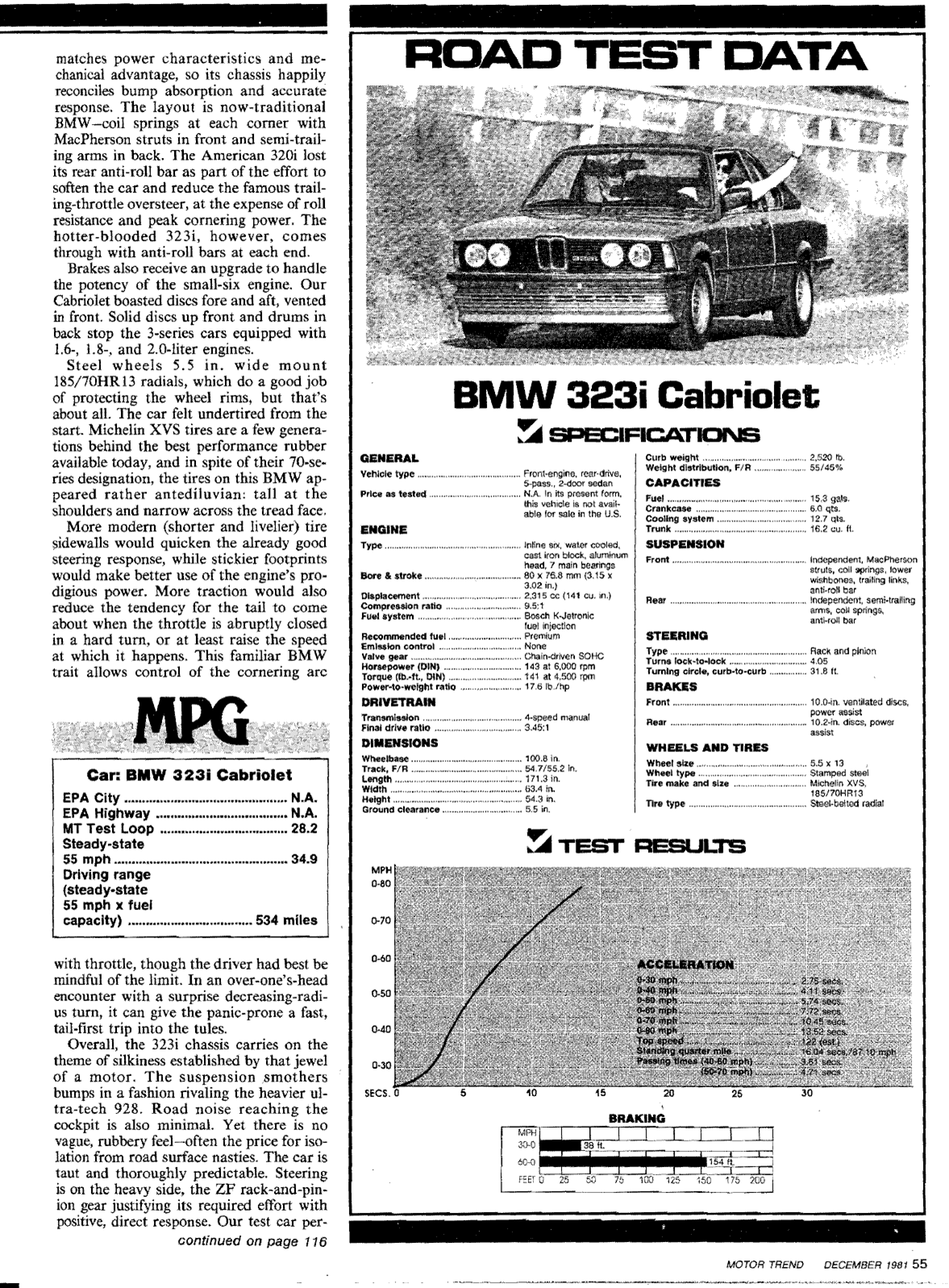
Inside, the car will not be
substantially changed in its preparation for U.S.-government approval, and
that's good. The fascia, seats, and trim are all done in a straightforward and
handsome fashion. As in the virtually identical (in this department) 320i, the
sense of richness comes from clean design, good materials, and flawless
workmanship, not a plethora of decorative wrinkles and tacked-on trim bits. Our
black-on black interior had leather bucket seats, well-executed molded plastic
panels, and the same flat, 15-inch leather-rimmed wheel installed in the M
1.
An entertaining touch we assume will remain with the car is the
European tachometer. A red band begins at the maximum recommended engine speed
(6,400 rpm), which is normal enough. But there is also a green band stretching
across the lower numbers. This is fun because the band is tapered-engine speeds
become less and less acceptable as they get higher-and dies out at 5,500 rpm.
The factory declines comment on operation between 5,500 and 6,400 rpm. It's a
clever twist and does seem to have the right psychological effect.
This
whole car has a good psychological effect, especially on enthusiasts of the
driving art. Like all 3-series Bimmers, it melds efficiency with finesse and
unbounded competence. These cars exude good taste while also serving dependably
as transportation. No wonder they keep a tenacious grip on their value as the
miles and years roll by.
The upgrades that are coming as part of
Century's federalized 323i program will further elevate this car's talent and
value. For the right to be among the lucky few who will own one of these
distinctive automobiles, buyers will ante up something like
$31,000.
Surely that's a lot of money, but there's no denying it will be
buying a lot of car (and prestige, and satisfaction). We were taken by the
abilities of the delightful 323i in its "normal" form. What will the legalized
Cabriolet be like, sporting tauter suspension, grippy tires, and a few pounds of
turbo boost? Holy blitzkrieg!
We'll have a full "after" test of the
Sunbeamer when the compliance/super-tuning work is completed. One thing we know
right now: Those poor souls in Europe are going to be gazing over here with a
brand of jealousy and frustration that used to be the sole province of American
enthusiasts.